When the Hubble Space Telescope turns its gaze toward distant heavens, it often captures celestial objects that challenge our understanding of cosmic evolution. One such object is NGC 1266, a galaxy that appears serene yet holds dramatic secrets. This lenticular galaxy, located about 100 million light-years away in the constellation Eridanus, is a rare post-starburst system—a transitional phase between a star-forming spiral and a quiet elliptical. In this listicle, we explore seven fascinating facts about NGC 1266 derived from recent Hubble observations, revealing the dynamic processes that shape galaxies over cosmic time.
1. A Striking Hubble Portrait
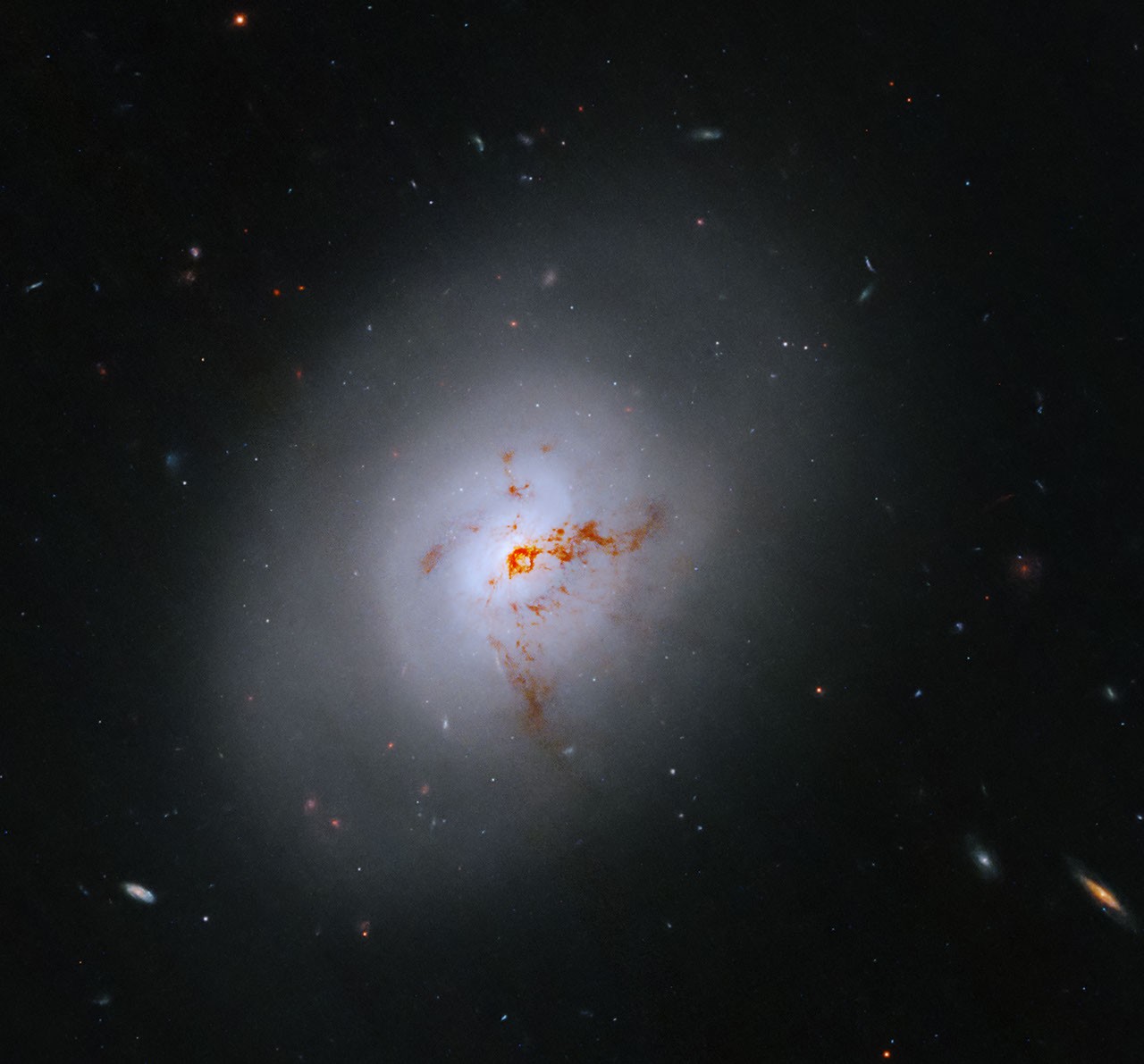
The Hubble image of NGC 1266 (shown at the top) displays a galaxy with a bright, compact center and a face that hints at spiral structure, yet it lacks visible spiral arms. Instead, reddish-brown clumps and filaments of dust partially obscure its full face. Through its diffuse outer regions, distant galaxies shine in red, blue, and orange light, dotting the ink-black background. This portrait was processed by image specialists to bring out subtle details, making it a favorite among astronomers and space enthusiasts alike. The image reveals not just the galaxy’s shape but also the traces of its turbulent past.
2. What Is a Lenticular Galaxy?
Lenticular galaxies, like NGC 1266, are often called the “missing link” in galaxy evolution. They are lens-shaped, with a bright central bulge and a flattened disk—similar to spiral galaxies. However, they have no spiral arms and little to no ongoing star formation, much like elliptical galaxies. Astronomers classify them as transitional objects that lie between spirals and ellipticals. In NGC 1266, the disk appears smooth and featureless, but the bright core and dim outer regions are hallmarks of this unusual type. Understanding lenticulars helps scientists piece together how galaxies change over billions of years.
3. Location in the Celestial River
NGC 1266 resides in the constellation Eridanus, the Celestial River, a winding constellation that stretches across the southern sky. At a distance of about 100 million light-years, this galaxy is relatively nearby compared to many cosmic objects studied by Hubble. Its location places it within the local universe, allowing detailed observations that would be impossible for more remote galaxies. The constellation Eridanus is named after a river in Greek mythology, and its deep-sky treasures, including NGC 1266, make it a popular target for both amateur and professional astronomers.
4. A Rare Post-Starburst Phase
What makes NGC 1266 truly intriguing is its post-starburst nature. Approximately 1% of local galaxies are post-starburst—meaning they experienced a major burst of star formation in the past but have since quieted down. Such galaxies host a young population of stars but lack active star-forming regions. NGC 1266’s bright stellar core and lack of emission nebulae indicate that its star formation has largely ceased. This transitional phase is brief, lasting only a few hundred million years, making these galaxies crucial for studying how galaxies evolve from vigorous star-forming systems to quiescent ones.

5. The Minor Merger That Changed Everything
Astronomers believe that NGC 1266 underwent a minor merger with another galaxy roughly 500 million years ago. This event did not destroy the galaxy but instead triggered a burst of star formation and funneled gas toward its center. The merger also increased the mass of the galaxy’s central bulge, reshaping its structure. Such minor mergers are common in the universe and can alter a galaxy’s fate without completely disrupting its form. For NGC 1266, this collision set the stage for its current post-starburst state and the activation of its central supermassive black hole.
6. An Active Galactic Nucleus
The merger’s influx of gas into the galaxy’s center did more than spur star formation—it also fed the supermassive black hole at NGC 1266’s core. As additional matter accumulated, the black hole became highly active, creating an active galactic nucleus (AGN). AGNs are among the most energetic phenomena in the universe, often outshining their host galaxies. In NGC 1266, the AGN is visible as a bright, compact core in Hubble images. Studying this AGN helps astronomers understand how galaxy mergers can trigger black hole activity and how such activity can influence the host galaxy’s further evolution.
7. Why This Galaxy Matters for Cosmic Evolution
NGC 1266 is more than a beautiful image—it’s a laboratory for galaxy evolution. As a post-starburst galaxy with an active nucleus, it represents a fleeting stage through which many massive galaxies may pass. By studying objects like this, astronomers can refine models of how galaxies transform from star-forming spirals into quiescent ellipticals. The data from Hubble, combined with other observatories, provide insights into the interplay between star formation, mergers, and black hole growth. Understanding these processes is essential for explaining the diversity of galaxies we see today and for predicting the future fate of our own Milky Way.
In conclusion, NGC 1266 offers a rare window into a pivotal moment in a galaxy’s life. Its lenticular shape, post-starburst population, and active nucleus all tell a story of change—a transformation set in motion by a cosmic merger half a billion years ago. As Hubble continues to capture such transitional objects, we gain a deeper appreciation for the dynamic, ever-changing universe we inhabit.