WebAssembly has long been a cornerstone of high-performance web applications, but recent advancements in Chrome M137 are pushing the envelope even further. By introducing speculative optimizations—previously reserved for JavaScript—V8 now unlocks faster execution for WebAssembly, especially for garbage-collected languages like Dart, Java, and Kotlin. This article breaks down seven essential concepts behind these new techniques, from deoptimization to inlining, and explains how they deliver measurable speedups in real-world scenarios.
1. Speculative Optimizations: The Core Idea
Speculative optimizations allow a compiler to make educated guesses about future program behavior based on past execution patterns. In V8, this means generating ultra-fast machine code under the assumption that certain conditions—like variable types or function targets—will remain consistent. If those assumptions later prove false, the engine can gracefully recover through a process called deoptimization. This technique has been a powerhouse for JavaScript performance, and now it’s being adapted for WebAssembly. The key advantage is speed: by avoiding generic, slower code paths, programs can run significantly faster without sacrificing correctness.
2. Deoptimization: The Safety Net
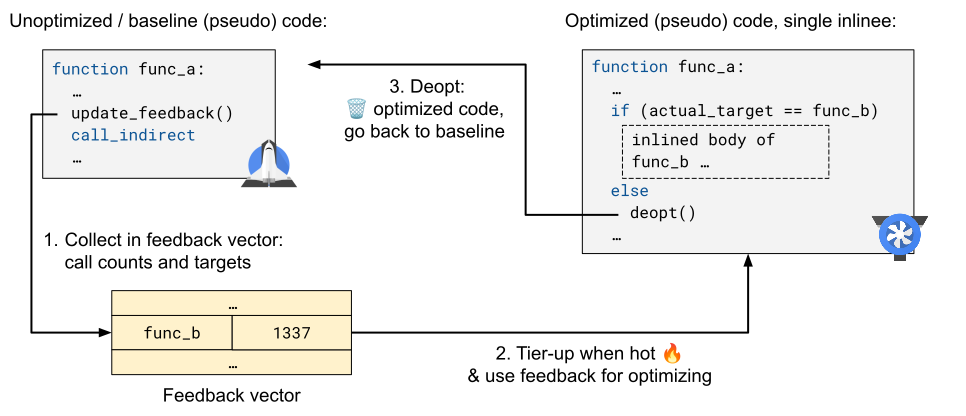
Deoptimization, or “deopt,” is the mechanism that rolls back optimized code when an assumption turns out to be wrong. Imagine a compiler that assumes a variable is an integer, but later the code passes a string. Without deopt, the optimized code would either crash or produce incorrect results. With deopt, V8 throws away the optimized code and reverts to a slower, more robust implementation—while simultaneously collecting fresh feedback to guide future optimizations. For WebAssembly, this safety net is brand new. It was never needed in the early days because WebAssembly’s static typing eliminated most guesswork, but with WasmGC’s dynamic features, deopts become indispensable.
3. Why WebAssembly 1.0 Didn’t Need Speculative Optimizations
When WebAssembly 1.0 launched in 2017, it was designed for languages like C, C++, and Rust, which rely on static compilation. Toolchains such as Emscripten and LLVM already performed aggressive ahead-of-time (AOT) optimizations, producing highly efficient binaries. The type system was rigid—every instruction and variable had a fixed type—so there was little uncertainty to exploit. As a result, speculative optimizations and deopts would have added complexity with minimal benefit. The existing AOT approach already delivered near-native performance, making further speculation unnecessary.
4. The WasmGC Revolution: Why Everything Changed
With the introduction of WebAssembly Garbage Collection (WasmGC), the landscape shifted. WasmGC brings support for higher-level languages such as Java, Kotlin, and Dart by introducing rich types like structs, arrays, and interfaces, complete with subtyping and dynamic dispatch. These features inject runtime uncertainty into previously predictable binaries. For example, a method call might target any subclass, making it impossible to know the exact function at compile time. Speculative optimizations become crucial here: the compiler can observe which subclass is most often used and inline that specific call, betting on the common path. WasmGC thus transforms WebAssembly from a fully deterministic environment into one where runtime feedback drives performance.
5. Speculative call_indirect Inlining: A Game Changer
One of the two headline optimizations in Chrome M137 is speculative call_indirect inlining. In WebAssembly, indirect function calls go through a table, which inherently adds overhead. The compiler must fetch the function pointer, check types, and then jump. Speculative inlining lets V8 observe which function is most frequently called at a given indirect call site. It then generates optimized code that directly calls that function, bypassing the table lookup and type check. If the program later uses a different function, deoptimization kicks in and the execution falls back to the generic path. This optimization alone can double the speed of certain WasmGC workloads, especially those with hot dynamic dispatch patterns.
6. Deoptimization for WebAssembly: How It Works
Implementing deoptimization for WebAssembly was nontrivial because the runtime state differs from JavaScript. V8 had to extend its deoptimization infrastructure to handle WebAssembly frames, including the ability to reconstruct the original linear memory and local variables. The process works similarly to JavaScript: when an assumption fails (e.g., a type mismatch or an unanticipated function target), the engine generates a deopt point that saves the current state. It then transitions to unoptimized code, where execution continues seamlessly. This mechanism is transparent to the developer and allows the compiler to take risks it otherwise wouldn’t, confident that any misstep can be corrected on the fly.
7. Real-World Impact: Performance Numbers and Future Potential
The combination of speculative inlining and deoptimization yields impressive speedups. On a set of Dart microbenchmarks, V8 observed an average performance gain of over 50%. For larger, realistic applications—including many that use WasmGC—the improvement ranges from 1% to 8%. While modest for some, these gains are achieved without any code changes, making them a free performance boost for existing WasmGC applications. Looking ahead, deoptimization opens the door to even more aggressive optimizations, such as speculative type specialization and dynamic code layering. As WebAssembly continues to evolve, these techniques will be essential for keeping pace with the demands of modern web applications.
Conclusion
Chrome M137 marks a pivotal moment for WebAssembly performance. By borrowing proven speculative optimization techniques from JavaScript—especially deoptimization and call_indirect inlining—V8 has unlocked significant speed gains for WasmGC programs. Developers targeting Java, Kotlin, Dart, or any garbage-collected language on the web can now enjoy faster execution out of the box, with no extra effort. As the WebAssembly ecosystem matures, expect even more sophisticated optimizations to build on this foundation, further narrowing the gap between web and native performance.